RADIANT — Radio Amateur Delay-tolerant Interplanetary Networking Testbed
From amateur packet radio to CubeSat relay to cislunar networking.
RADIANT brings Delay-Tolerant Networking (DTN) to amateur radio, enabling store-and-forward messaging across disrupted links from terrestrial ground stations to Low Earth Orbit (LEO) and ultimately to cislunar space. Current status: two-node terrestrial DTN operational (Raspberry Pi, Mobilinkd TNC4, Yaesu FT-817, 9600 baud G3RUH GFSK over VHF/UHF). All subsequent phases are in design or planning.
The project implements Bundle Protocol version 7 (BPv7) over amateur radio links using LTP wrapped directly in KISS framing. The architecture uses JPL's ION-DTN through a standardized interface, ensuring compatibility with NASA's reference DTN implementation. Station identification is achieved through callsign-embedded DTN Endpoint Identifiers (e.g. dtn://g4dpz/spacecraft) carried in every bundle's metadata, ensuring regulatory compliance while using numeric ipn:// addresses for efficient routing.
RADIANT — Radio Amateur Delay-tolerant Interplanetary Networking Testbed
Collaborate With UsCurrent Status
RADIANT is an early-stage project. Here is what exists today and what is planned.
- Two-node terrestrial DTN over VHF/UHF
- Hardware: Raspberry Pi + Mobilinkd TNC4 + Yaesu FT-817
- 9600 baud G3RUH GFSK — standard amateur packet modulation
- BPv7 bundles over LTP wrapped directly in KISS framing
- Ping and store-and-forward file delivery validated
- Simulated propagation delay (cislunar/interplanetary timing) in lab
- Callsign-embedded DTN Endpoint Identifiers for regulatory compliance
- Phase 1.5: QO-100 GEO satellite DTN demonstration
- Phase 2: CubeSat engineering model (STM32U585 + SDR)
- Phase 3: LEO CubeSat flight with ground-to-space DTN
- Phase 4: Cislunar S-band/X-band with FEC (LDPC)
- Adaptive modulation (4FSK, QPSK) replacing baseline GFSK
- Forward error correction (convolutional, Reed-Solomon, LDPC)
- Multi-engine DTN abstraction layer
- Source code repository (not yet public)
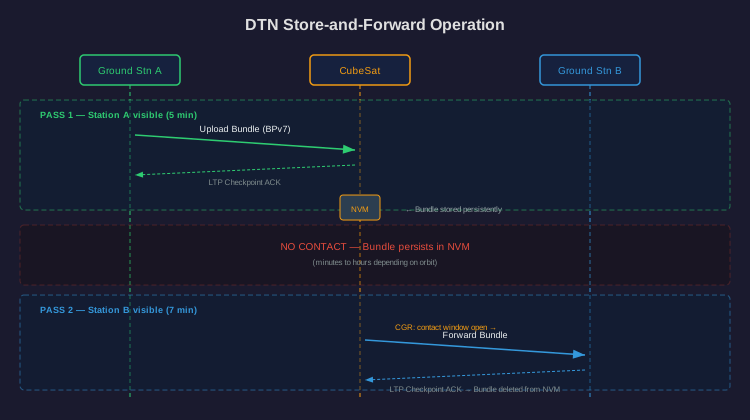
How Store-and-Forward Works
DTN bundles are uploaded during one pass window, stored persistently onboard, and forwarded to the destination when the next contact opens — no data lost due to disconnection.
Network Architecture
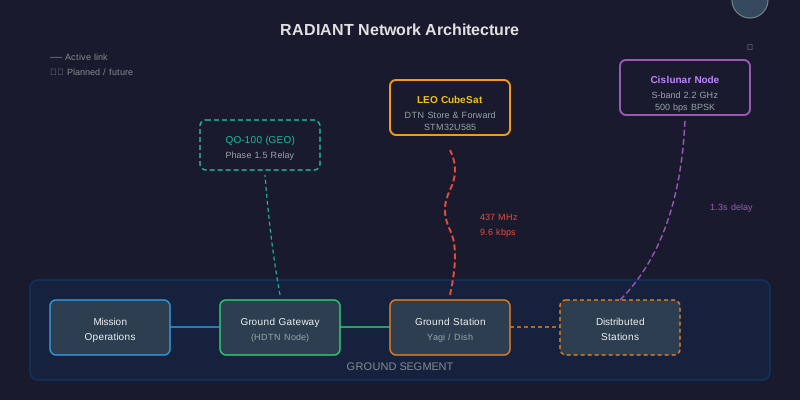
From terrestrial ground stations through GEO relay to cislunar deep space — all connected via standard DTN protocols.
What This Project Is
RADIANT is a networking-layer integration project, not a PHY-layer innovation project. The value is in making DTN work end-to-end over amateur radio links with proper regulatory compliance, contact scheduling, and store-and-forward semantics — then progressively improving the physical layer as we move toward space.
Amateur Radio as DTN Testbed
Amateur radio links are naturally disrupted, intermittent, and scheduled — exactly the environment DTN was designed for. LEO passes, QO-100 transponder slots, and terrestrial VHF links all exercise real DTN behaviours.
DTN Integration
Running the NASA/JPL interplanetary internet protocol suite (BPv7, LTP, CGR) on affordable amateur ground stations. The engineering is in the integration: LTP-over-KISS, callsign-embedded EIDs, contact plan management.
Phased Approach
Starting with proven, simple hardware (TNC4 + FT-817) and progressively moving to software-defined radio, adaptive modulation, and eventually flight hardware. Each phase validates the next.
Technical Capabilities (Operational + Planned)
Protocol Stack
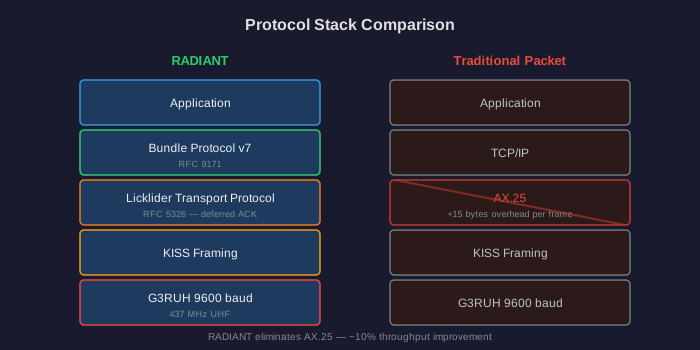
RADIANT eliminates AX.25 and wraps LTP directly in KISS framing — reducing overhead and improving throughput by ~10%.
Our Collaborators
This project is developed in collaboration with leading amateur satellite organisations.


Get Involved
We are actively seeking collaborators — amateur radio operators, researchers, universities, and space organisations.
Whether you can offer ground station partnerships, hardware contributions, flight opportunities, or software development expertise, we want to hear from you.
Contact Us to CollaborateMIT License