Concept of Operations
Terrestrial analogue architecture for cislunar DTN communications.
The Concept
The terrestrial analogue architecture mirrors the cislunar communications path: Mission Operations Node → Ground/Gateway DTN Node → Amateur/experimental RF link → Relay/Remote DTN Node → Payload application endpoint. Each terrestrial demonstration exercises the same DTN protocols, store-and-forward behaviour, and contact scheduling that a cislunar mission would require, using amateur radio links as realistic disrupted-network analogues.
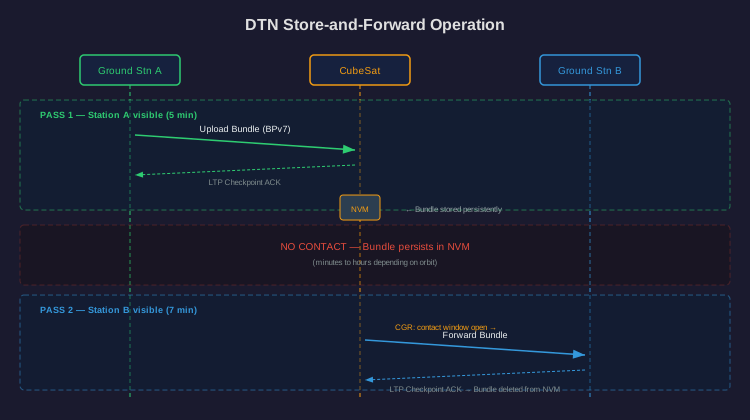
RF Link Types
The project uses a variety of amateur and experimental RF links as practical analogues for cislunar communication constraints:
- Amateur radio LTP-over-KISS (VHF/UHF at 9600 baud, callsign in DTN EID)
- Microwave point-to-point paths (10 GHz, 2.4 GHz)
- Satellite-style scheduled links (QO-100 transponder)
- EME-inspired operational patterns (moonbounce timing disciplines)
- Weak-signal / intermittent links (troposcatter, aircraft scatter)
Contact Graph Routing
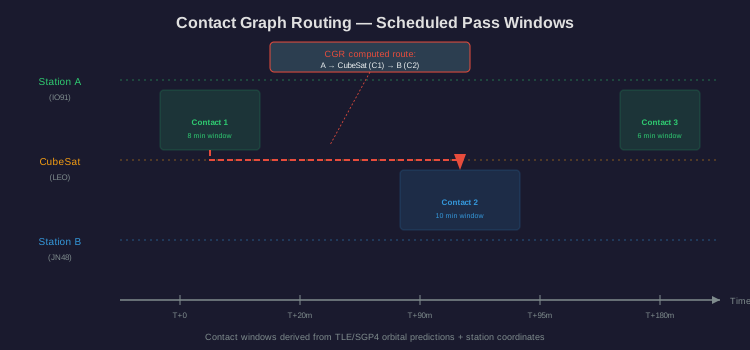
Bundles are routed through scheduled pass windows — CGR computes the optimal multi-hop path based on predicted contact times.
Why Amateur and Specialist Radio Communities Matter
These communities bring essential capabilities to the project:
Operation over difficult and intermittent RF paths
Disciplined link scheduling and station procedures
Experience with weak-signal and long-distance communication
Practical ground-segment engineering and experimentation
Collaborative culture suited to distributed demonstrations
Expected Outcomes
- ✓A credible terrestrial analogue for cislunar DTN operations
- ✓Operational evidence to support a flight experiment case
- ✓Multi-node contact graph enabling distributed ground station routing and store-and-forward relay via LEO/GEO
- ✓Automated contact plan distribution to all network nodes (API for ground, OTA bundles for space)
- ✓Stronger links between space networking and specialist amateur-radio communities
- ✓A clearer roadmap toward a cislunar payload demonstration of DTN-enabled networking
NASA References
Key NASA resources on Delay-Tolerant Networking and cislunar communications:
NASA Glenn: High-Rate Delay Tolerant Networking
NASA Glenn Research Center's HDTN programme page — architecture overview, capabilities, and mission context.
Delay/Disruption Tolerant Networking Tutorial
NASA educational resource introducing DTN concepts and architecture.
Delay/Disruption Tolerant Networking Overview
High-level overview of NASA's DTN programme.
NASA Delay Tolerant Networks: Operational, Evolving, and Ready for Expansion
Status report on NASA's operational DTN deployment.
A Communications Network for Cislunar Operations
NASA architecture for cislunar communication networks.